EXPLORATION OF THE SOUL:TCHAIKOVSKY & ADLER | Sunday, March 1, 2026 at 3PM | Programme Notes
Yefim Adler: Four Attributes of the Soul
Composer’s Notes
My work on the Four Attributes was long, painstaking and... infinitely joyful, providing strength to live and hope. Suffice to say that three out of four movements are writtenin Hebrew – a language I do not speak. I had to be extra careful to verify each Hebrew phrase and accent to make sure they sounded right. In the choral score, I was alternating horizontal voicing (I, III) with vertical (II, IV), but always aiming for each voice to be melodious and have its own line.
I’ve always had a very special relationship with the orchestra. Simply put, I am in love with it. I consider myself a very lucky composer, because back in Moscow I had unlimited access to its finest orchestras. In the Four Attributes, the orchestra in no way has only an accompanying function. It is not only an equal partner, but also, oftentimes, is carrying the main load.
The first movement, Poetical, is written after a poem by Yehuda Halevi, a wonderful XII century Jewish poet. His poetry is so imaginative and graceful that it literally turns into live pictures when you spend enough time with it. For example, in the middle sectionof the movement, I was imagining a male choir sitting in a circle, wearing all white and singing praise to God with clouds flowing gently above - quite a fascinating challenge for a composer. This movement is composed as a trio – soprano solo, tenor solo and a cappella choir – without emphasizing any one voice over the others.
The second movement, Divine, is an example of the Hebrew worship text (Sanctification) driving the musical form. It evoked associations with a Greek tragedy, with its chorus and a narrator. This part has a rondo form, with a refrain being a polyphonic duet of a male choir and a soloist. The orchestra is serene and graphic. The music here is very energetic, even joyful, ending in an impressive anthem of love and glory of God.
The third movement, Loving (from the Song of Songs): the challenge here was to take three phrases from the poem and turn them into six minutes of music. I was imagining a blurred impression of a woman with an umbrella walking through a garden in the rain – looking at her through a window covered with rain droplets, and strove to create the same impression in music. The orchestra here is light and transparent (strings only), with solo flute, vibraphone and harp.
The fourth movement, Devotional, demonstrates again how the Hebrew text was dictating rhythmic solutions. For example, stressed syllables are supported by accented strings which in turn made for quite peculiar rhythms. In the beginning of Devotional, the text is not sung but spoken by a male choir in its lowest register, marked “nearly mumbling”. Here I was trying to create an atmosphere of asceticism and archaism rather than reproduce text as such. Orchestral means are supporting this effect: the violins are used as percussion, hitting the strings col legno; lower muted strings are playing the same note, secco, mysteriously, in almost absolute silence (p, pp); percussion, in contrast, is literally shouting, suddenly and very loudly, “Let It Be” after each “Hallelujah” sung by the solo tenor. The choir speaks, the soloist sings, and the rest of the orchestra performs variegated functions, giving birth from the very beginning to a musical drama propelled by the percussion. In general, percussion is the locomotive that moves the entire construction of this movement. The orchestration here is luxurious, even chic.
The presence of organ, church bells, and tubular bells (with 2 performers 4 hands) give the orchestral sound a majestic and monumental character.
This movement is about interfaith – Praise the Lord All Ye Nations (that’s why it is written in Hebrew and English). Although this idea is not new – Beethoven’s 9th proclaimed it two centuries ago – it is good to remind the human race once again that their only option for survival is to stay together.
Tchaikovsky: Manfred Symphony, op. 58
Tchaikovsky’s Manfred Symphony tells the story of a soul in conflict. Inspired by Lord Byron’s dramatic poem, the work traces the psychological journey of Manfred - a figure consumed by regret, longing, and the search for redemption.
Here, Tchaikovsky abandons classical restraint in favor of emotional extremes. The work unfolds through heightened contrasts of texture and affect, reflecting Tchaikovsky’s intimate expressive voice. Manfred stands as one of his most personal and uncompromising works; a symphony driven not by form, but by feeling.
Listeners may notice that the symphony is unified by a recurring theme associated with Manfred himself, first heard in a dark, searching guise and continually transformed across the four movements. This thematic material resurfaces in contrasting emotional states - brooding and inward, violently agitated, and finally transfigured - mirroring the protagonist’s psychological evolution. Tchaikovsky’s orchestration plays a crucial role in this narrative: stark contrasts between dense, turbulent textures and moments of fragile lyricism heighten the sense of inner conflict, allowing the orchestra itself to function as a voice of Manfred’s conscience.
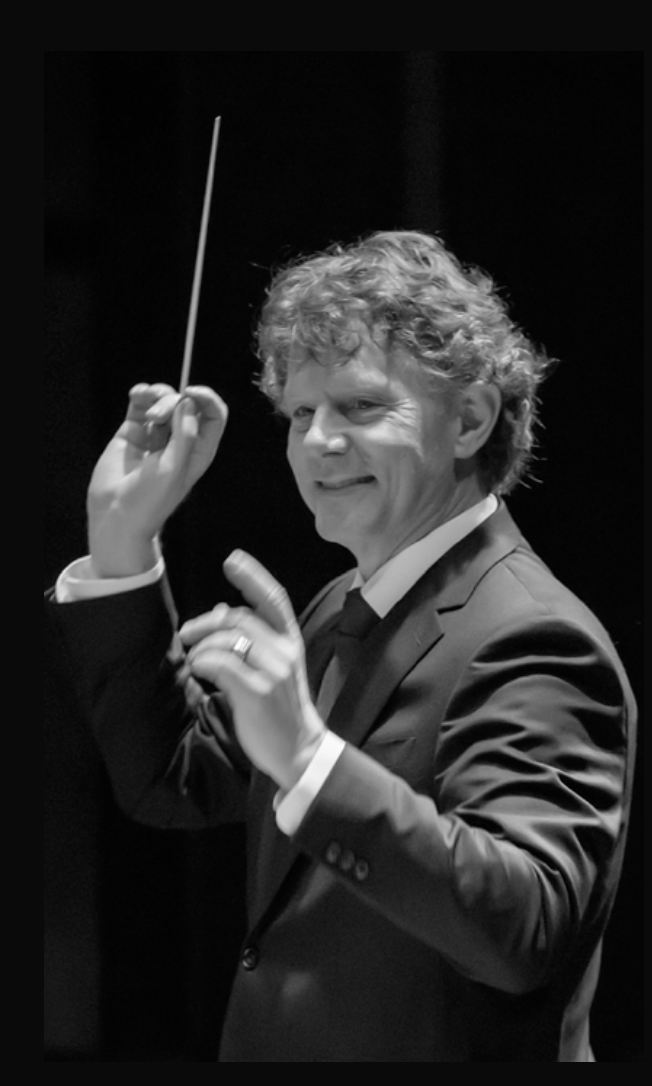
Michael Newnham
Music Director
Michael Newnham is best known for his intense and inspiring conducting style, based on a deep knowledge of the score and informed by a strong interest in languages, cultures and history. A born communicator, his open and direct contact with musicians and audiences creates performances full of expression and energy.
Along with being Music Director of Orchestra Toronto, he is also Music Director of the Peterborough Symphony Orchestra, and also held that title with Symphony New Brunswick and Camerata NB. Newnham has been instrumental in bringing these ensembles to new artistic heights and raising their profile on the provincial and national level.
Along with appearances in his native Canada, Newnham has also appeared at the helm of many orchestras and opera companies throughout Poland, Slovakia, the Czech Republic, Hungary, Austria, Italy and South Korea.
Endowed with a special passion and gift for working with young musicians, Michael founded the Kawartha Youth Orchestra in 2002, and has been a faculty member as conductor and chamber music coach at Music at Port Milford for several years. His involvement in educating young musicians is not limited to Canada. He spent two years as Guest Professor and Orchestra Conductor at Taegu-Hyosung University in South Korea.
Originally from Hamilton, Newnham is a graduate of the conducting class of prof. Bogusław Madey at the Chopin Academy of Music in Warsaw, Poland. He also studied at the Indiana University of Music and at the University of Toronto. A recipient of several awards, including the “Order of Merit” from the Republic of Poland, the “Best Conductor” Award from the East Slovakian State Opera, Newnham was recently granted the Turzanski Award for his services in promoting Polish music and culture in Canada.
Collaboration with Canadian composers has been central to Newnham’s life in music. In the summer of 2005, he was specially honoured to have been chosen by R. Murray Schafer to be the Music Director of an acclaimed production of Schafer’s “Patria: The Enchanted Forest”.
Before taking up the baton, Newnham began his musical career as a trombonist, playing with the Toronto and Kitchener-Waterloo Symphonies, as well as a member of the National Youth Orchestra of Canada. He currently lives in Peterborough with his wife, cellist Zuzanna, two daughters, and three cats, and is a home barista.

ABOUT ORCHESTRA TORONTO
Founded in 1954 as the Bennington Heights Community Orchestra and rebranded as Orchestra Toronto in 1998, our organization stands as a testament to the enduring power of music in building connections and enriching lives. From its humble beginnings, Orchestra Toronto has grown to become one of Canada’s oldest and largest volunteer orchestras, proudly serving the Greater Toronto Area and beyond with passion and dedication.
As we look towards the future, Orchestra Toronto remains steadfast in our commitment to entertaining and inspiring diverse communities. We envision a world where the love of symphonic music is embraced by future generations, and we are dedicated to making this vision a reality.
Join us on this musical journey as we continue to enrich lives, foster connections, and celebrate the transformative power of music.