Darth Vader Meets The Godfather | January 24, 2026 7:30 PM | Programme Notes
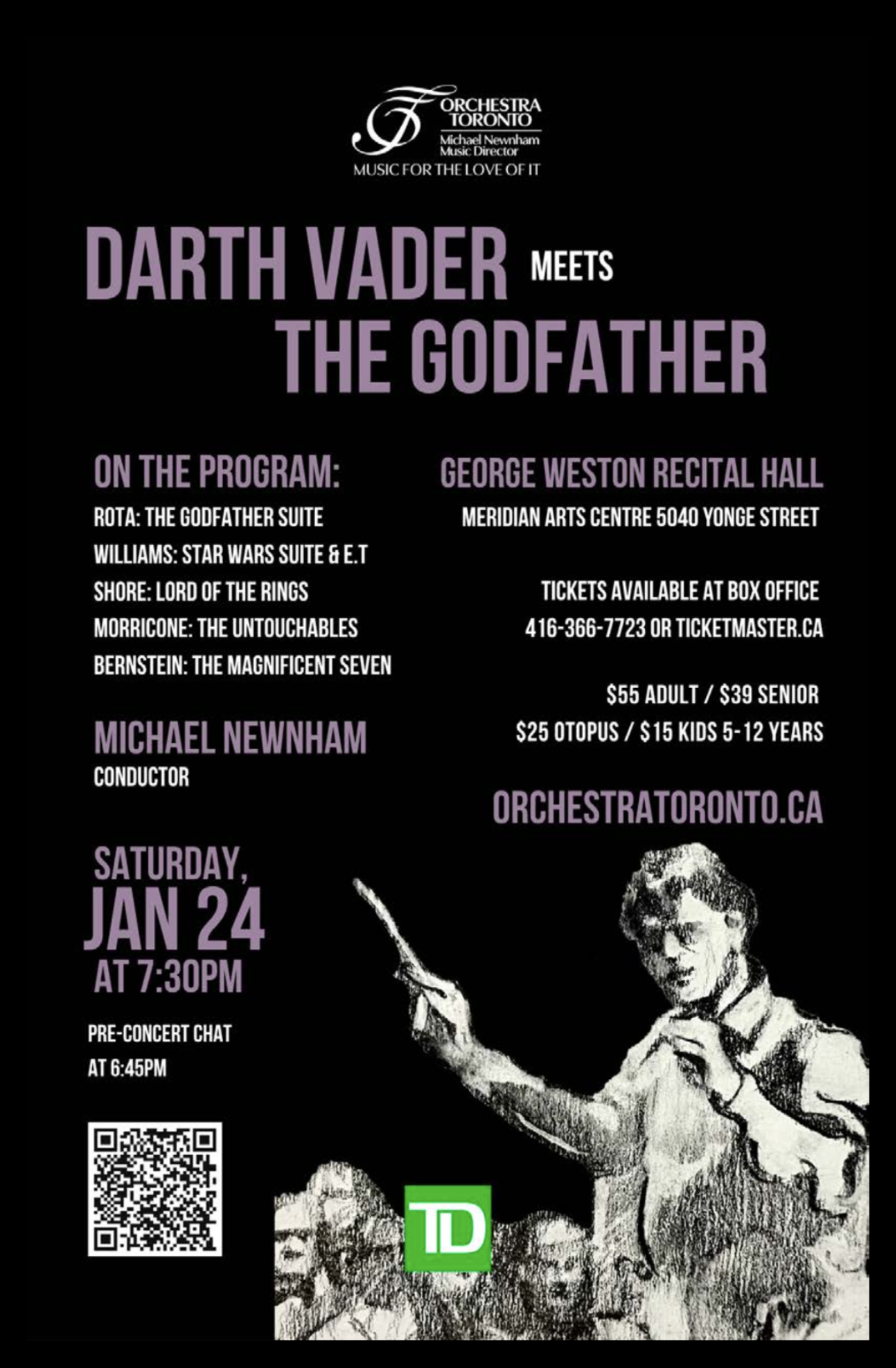
PM
Programme Notes: Darth Vader Meets The Godfather
Film music has long served as one of the most potent intersections between popular culture and the symphonic tradition. In the hands of the twentieth and twenty-first century’s most celebrated film composers, the orchestra becomes not merely accompaniment, but a narrative force: shaping character, articulating emotion, and giving sonic dimension to imagined worlds. Orchestra Toronto’s Darth Vader Meets the Godfather brings together iconic scores that have transcended their cinematic origins, illuminating the artistry of composers who seamlessly integrate classical techniques with the demands of modern storytelling. Heard in the concert hall, these works encourage us to recognize film music not only in its cinematic context but also as engaging and thoughtful contributions to the broader orchestral tradition.
John Williams: E.T.: The Extra-Terrestrial: Adventures on Earth
John Williams’ score for E.T. has become emblematic of the expressive power of late-twentieth-century film music, distinguished by its thematic clarity, luminous orchestration, and emotional immediacy. Adventures on Earth functions as a symphonic summation of the narrative: beginning with rhythmic urgency and child-like wonder before expanding into sweeping, celestial lyricism. Williams deploys the full resources of the orchestra - radiant strings, expansive brass writing, and intricate woodwind figuration, to evoke both the innocence of childhood and the transcendence of its imaginative possibilities. The celebrated “flying theme,” which crowns the movement, exemplifies Williams’ gift for crafting melodies that balance simplicity with symphonic grandeur. In the concert hall, the music stands independently as a compelling story of aspiration, discovery, and the boundless human capacity for connection.
Ennio Morricone: The Untouchables Suite
Ennio Morricone’s score for The Untouchables occupies a unique space in his vast catalogue, blending the composer’s characteristic lyricism with a sharply etched musical depiction of Prohibition-era Chicago. This suite juxtaposes contrasting musical materials: energizing, staccato rhythms that conjure the ever-present tension of the city’s criminal underworld; lyrical themes of heroic resolve; and passages of unmistakably Morricone-like emotional directness. The score’s structural clarity reflects Morricone’s classical training, while its expressive gestures reveal his instinct for character-driven musical narrative. Particularly notable is the noble thematic material associated with Eliot Ness, which imbues the drama with an almost operatic moral dimension. Presented in suite form, the music reveals its symphonic rigor, affirming Morricone’s reputation as a composer who navigated effortlessly between avant-garde experimentation and broadly communicative cinematic writing.
Nino Rota: The Godfather Suite
Nino Rota’s music for The Godfather remains one of the most culturally resonant film scores of the twentieth century. Rooted in Italian melodic tradition, the score fuses elements of Sicilian folk music with lush orchestral textures, creating a sonic world that reflects both the familial intimacy and the tragic grandeur of the Corleone saga. The celebrated waltz theme, simultaneously elegant, nostalgic, and shaded with fatalism, serves as the emotional fulcrum of the narrative, encapsulating the tension between loyalty and power that defines the film. This suite traces the rich thematic landscape of the trilogy, moving between intimate chamber-like writing and more expansive, operatic sonorities. Rota’s gift for melodic invention, coupled with his nuanced harmonic language, underscores the paradox at the heart of the story: that beauty and brutality can coexist within the same musical breath.
Elmer Bernstein: The Magnificent Seven: Symphonic Suite
Elmer Bernstein’s score for The Magnificent Seven has become virtually synonymous with the sound of the American Western. Characterized by galloping rhythmic figures, bold brass fanfares, and an unmistakable sense of forward momentum, the music evokes not only the physical landscapes of the frontier but also the moral and mythic dimensions of the genre. Bernstein’s orchestral writing demonstrates remarkable clarity, with a lean, energetic style that reflects both Aaron Copland’s influence and Bernstein’s own distinctive musical vocabulary. The resulting symphonic suite captures the camaraderie, tension, and heroism that drive the narrative, transforming the film’s dramatic arc into a vibrant orchestral essay. Heard today, the score remains a quintessential example of how music can help construct, and perpetuate, the mythology of American storytelling.
Howard Shore: The Lord of the Rings: The Fellowship of the Ring
Howard Shore’s score for The Lord of the Rings trilogy represents one of the most ambitious and intricately constructed film music projects of the early twenty-first century. Drawing on a sophisticated system of leitmotifs, Shore crafts a musical world that parallels the complexity and depth of Tolkien’s literary universe. The Fellowship of the Ring introduces many of these foundational musical ideas: the pastoral lyricism of the Shire, articulated through modal melodies and folk-like instrumentation; the serene yet ancient sonorities of the Elves; and the dark, inexorable motifs associated with Mordor and the Ring itself. Shore’s orchestral and choral writing is expansive, integrating influences from medieval chant, world music traditions, and late-Romantic symphonic practice. In performance, this selection reveals the architectural intelligence of Shore’s approach and the profound emotional resonance that has made the score a defining achievement of contemporary film music.
John Williams: Star Wars Suite
Perhaps no film score has more profoundly shaped the soundscape of modern cinema than John Williams’ Star Wars. Drawing upon the symphonic tradition of composers such as Korngold, Holst, and Stravinsky, Williams revitalized the classical Hollywood style through a rich tapestry of leitmotifs that delineate characters, ideologies, and dramatic arcs. The Star Wars Suite assembles several of the series’ most emblematic themes: the heroic main title with its unmistakable brass fanfare; the soulful, lyrical theme for Princess Leia; the ominous “Imperial March” that has become an instantly recognizable cultural emblem; and others. Williams’ masterful orchestration and structural clarity allow the music to function both as narrative accompaniment and as standalone symphonic fare. In the concert hall, the Suite reveals its architectural strength and its enduring power to evoke awe, conflict, and the mythic scale of the Star Wars universe.
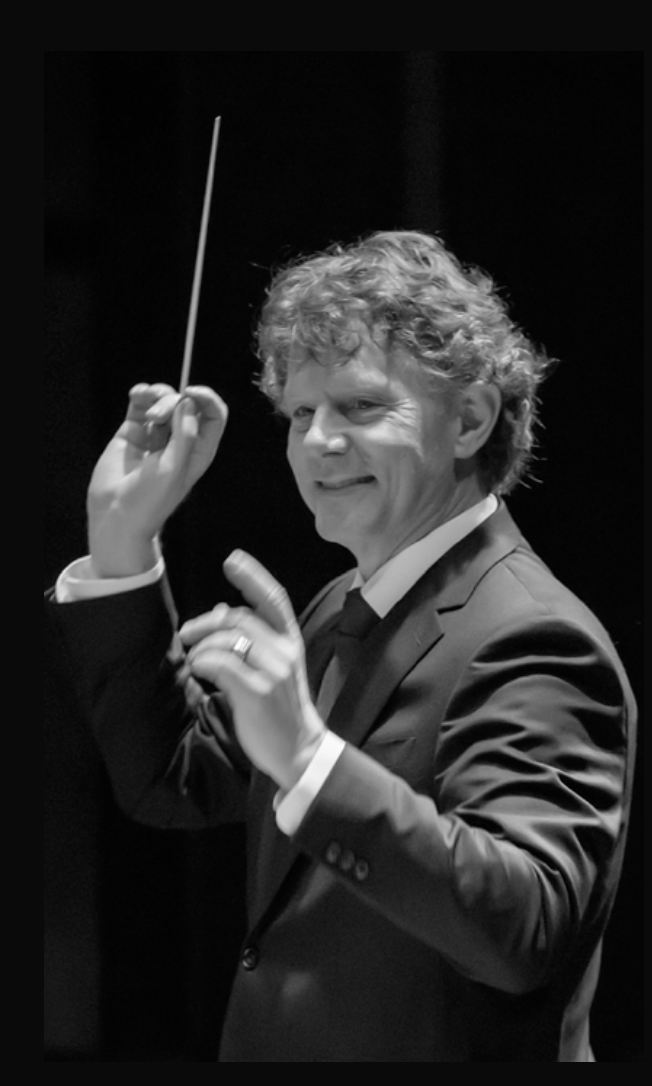
Michael Newnham
Music Director
Michael Newnham is best known for his intense and inspiring conducting style, based on a deep knowledge of the score and informed by a strong interest in languages, cultures and history. A born communicator, his open and direct contact with musicians and audiences creates performances full of expression and energy.
Along with being Music Director of Orchestra Toronto, he is also Music Director of the Peterborough Symphony Orchestra, and also held that title with Symphony New Brunswick and Camerata NB. Newnham has been instrumental in bringing these ensembles to new artistic heights and raising their profile on the provincial and national level.
Along with appearances in his native Canada, Newnham has also appeared at the helm of many orchestras and opera companies throughout Poland, Slovakia, the Czech Republic, Hungary, Austria, Italy and South Korea.
Endowed with a special passion and gift for working with young musicians, Michael founded the Kawartha Youth Orchestra in 2002, and has been a faculty member as conductor and chamber music coach at Music at Port Milford for several years. His involvement in educating young musicians is not limited to Canada. He spent two years as Guest Professor and Orchestra Conductor at Taegu-Hyosung University in South Korea.
Originally from Hamilton, Newnham is a graduate of the conducting class of prof. Bogusław Madey at the Chopin Academy of Music in Warsaw, Poland. He also studied at the Indiana University of Music and at the University of Toronto. A recipient of several awards, including the “Order of Merit” from the Republic of Poland, the “Best Conductor” Award from the East Slovakian State Opera, Newnham was recently granted the Turzanski Award for his services in promoting Polish music and culture in Canada.
Collaboration with Canadian composers has been central to Newnham’s life in music. In the summer of 2005, he was specially honoured to have been chosen by R. Murray Schafer to be the Music Director of an acclaimed production of Schafer’s “Patria: The Enchanted Forest”.
Before taking up the baton, Newnham began his musical career as a trombonist, playing with the Toronto and Kitchener-Waterloo Symphonies, as well as a member of the National Youth Orchestra of Canada. He currently lives in Peterborough with his wife, cellist Zuzanna, two daughters, and three cats, and is a home barista.
ABOUT ORCHESTRA TORONTO
Founded in 1954 as the Bennington Heights Community Orchestra and rebranded as Orchestra Toronto in 1998, our organization stands as a testament to the enduring power of music in building connections and enriching lives. From its humble beginnings, Orchestra Toronto has grown to become one of Canada’s oldest and largest volunteer orchestras, proudly serving the Greater Toronto Area and beyond with passion and dedication.
As we look towards the future, Orchestra Toronto remains steadfast in our commitment to entertaining and inspiring diverse communities. We envision a world where the love of symphonic music is embraced by future generations, and we are dedicated to making this vision a reality.
Join us on this musical journey as we continue to enrich lives, foster connections, and celebrate the transformative power of music.
ORCHESTRA TORONTO
MUSICIANS
VIOLIN I:
Corey Gemmell (cm)
Michele Clemo
Blerina Foto
Victoria Gilerovitch
Yani Hausman
Vivian Koen
Alexander Lam
Grace Morrison
Katie Stephens
Parker Tan
VIOLIN II:
Ines Pagliari (p)
Ho Kwan (Michael) Au
Geral Billinghurst
Ralph Bose
Hei Kan Chow
Saghi Farsijani
Chris Klochek
Michael Lee
David O’Brien
Pia Pace Asciak
Carolyn Rogers
Sana Shepko
Donald Yoon
VIOLA:
Elizabeth Morris (p)
Harikoa Bronsdaughter-George
Daeun (Dannah) Jeong
Veronica Koopmans
Karly Leung
Michael Luxton
Uri Samson
Nora Webster
Heather Whitney
CELLO:
Zuzia Newnham
Lou Bacs
Jamie Hlusko
Sam Horodezky
Claire le Riche
Jane Litherland
Michael Lordly
Norman Rosenblum
Allison (Allie) Scott
Wendy Shih
Matthew Thompson
Daniel Yoo
BASS:
John Wiener
Tomas Casciato
Melissa Cavelti
Eric Mykhalovskiy
Radek Puky
Frank Santopuoli
Jack Schachner
FLUTE:
Esther Choi (p)
Rachel Roe-Wu
OBOE:
Cristina Sewerin (cp)
James Manson
CLARINET:
Noru Gogovita
Danielle Waxer
BASS CLARINET:
Helen Li
BASSOON:
Kristin Day (p)
Dorothy Ward
FRENCH HORN:
Samir Abd-Elmessih (p)
Jessica Lin
Rebecca Davies
Avram Selick
TRUMPET:
Tony Ruan (p)
John McGregor
Donovan Fuller
TROMBONE:
Abellia Chan (p)
Ryan Minten
Alex Allsopp
TUBA:
Steve Vettese
TIMPANI:
Serge Adler (p)
PERCUSSION:
Phoenix Mok-Wong
Keshav Sharma-Jaitly
Daniel Smadja
HARP:
Liane James
PIANO:
Maziar Heidari
(cm) Concertmaster
(p) Principal
(cp) Co Principal

ORCHESTRA TORONTO
BOARD
OF DIRECTORS & STAFF
EXECUTIVE COMMITTEE
Melissa Cavelti, chair
Chris Dassios, co-vice-chair
Trevor Fairlie, co-vice-chair
Alexis Paradis, treasurer
Jennifer Lee, secretary
DIRECTORS
Laurie Brovold
Alexis Choi
Annie Hu
Grace Morrison*
Steve Vettese*
Donna Walrond
*Musicians’ Committee
MUSIC DIRECTOR
Michael Newnham
EXECUTIVE DIRECTOR
Alysha Addetia
ADMINISTRATION
John McGregor, librarian and stage manager
Blerina Foto, personnel manager
Brittany Stout, social media coordinator
Rajvi Dedhia, rehearsal & social media support
VOLUNTEERS
Noreen Willoughby
Hussein Rajabali
GRAPHIC DESIGNER
Paige Dandelé
JOIN ORCHESTRA TORONTO’S
LEGACY CIRCLE
Orchestra Toronto is honoured to recognize the generosity of those who have included us in their estate plans, ensuring that symphonic music continues to flourish for generations to come.
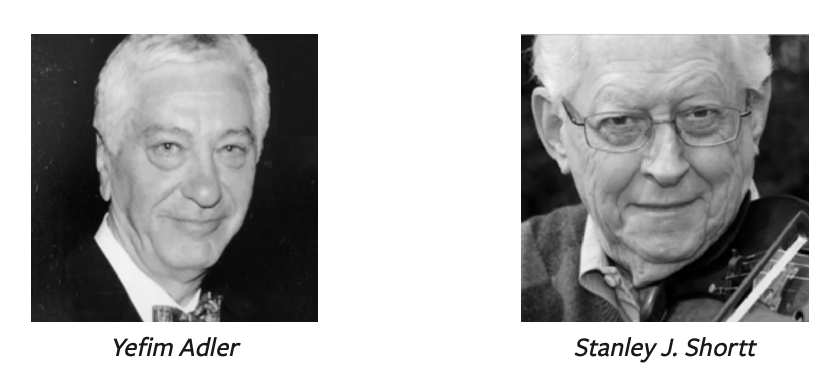
We are especially grateful for the bequests of Yefim Adler and Stanley J. Shortt, whose lasting gifts help support our mission and enrich our community. This page is dedicated to celebrating those who make a meaningful and enduring impact through legacy giving—a testament to the vision, passion, and generosity of our supporters.
You can help shape the future of music in our community. For more information on making a bequest, please contact Alysha Addetia at executive.director@orchestratoronto.ca or 416.358.5685.
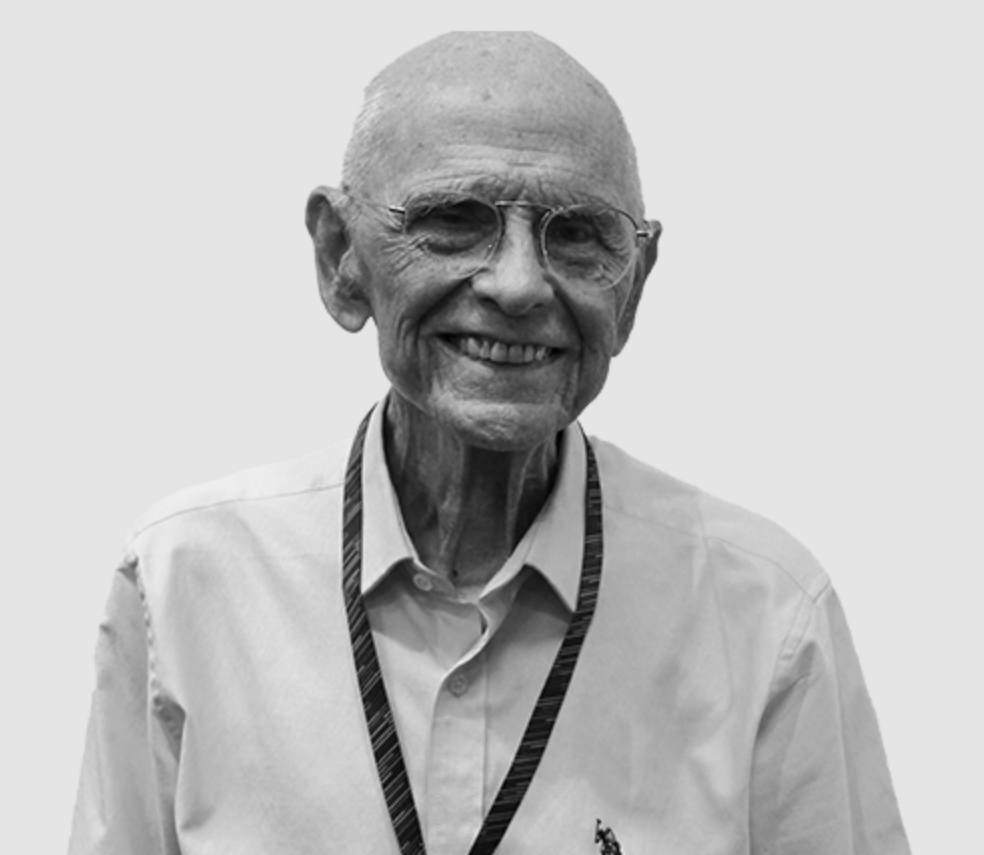
Orchestra Toronto is proud to introduce our Legacy Giving Program, designed to honour and recognize individuals who have made a significant impact on our organization. Visit our website to learn more about this program and how you can honour someone special.
Past Donations: For his more than half century devotion to Orchestra Toronto and its predecessors, we honour Rick Murrin with the first Legacy Chair - Bass Section. Rick retired from the orchestra at the end of the 2023/24 season at age 92.
Generously donated by Jack Schachner, Melissa Cavelti, Jon Powell, Eric Mykhalovskiy, John Wiener, Tomas Casciato, Radek Puky, Frank Santopuoli, Stephen Bright & Heather Whitney.

Scan for more info or to make a donation.
OUR PROUD SPONSORS
Orchestra Toronto has sponsorship opportunities to suit every budget. Please get in touch so we can work together to create a custom opportunity for you to partner with one of Canada’s premier community ensembles.
Please email executive.director@orchestratoronto.ca for more information.