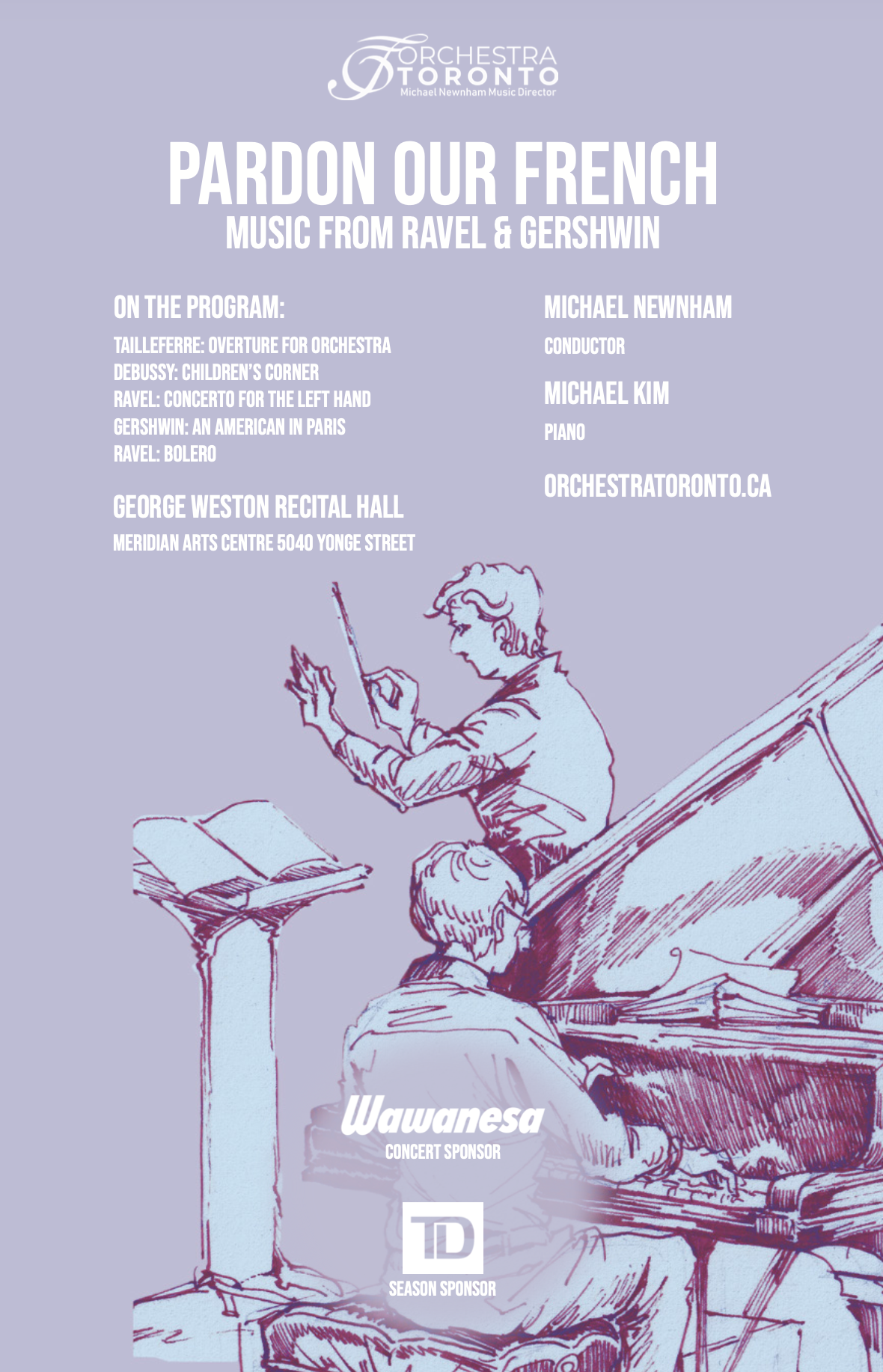
Pardon Our French - Music from Ravel & Gershwin - Sunday, April 19, 2026 at 3PM
Germaine Tailleferre: Ouverture
Germaine Tailleferre, the only female member of the Parisian collective Les Six, built her musical language around clarity, wit, and structural economy. Composed in 1949, Ouverture reflects the group’s reaction against late-Romantic excess and Impressionist atmosphere, favoring instead crisp orchestration and neoclassical balance. Rather than a grand symphonic introduction in the nineteenth-century sense, the work functions as a compact orchestral study in rhythmic vitality and shifting instrumental colour.
Ouverture unfolds through a sequence of tightly organized contrasting ideas, moving quickly between buoyant wind writing, agile string passages, and bright brass interjections. Tailleferre’s orchestration is notably transparent; instrumental lines remain clearly articulated even in dense moments, and timbre becomes a primary structural element. Listeners may notice the playful dialogue between winds and strings, as well as the composer’s subtle harmonic turns that avoid predictable cadences. The result is a concise and energetically crafted work that showcases Tailleferre’s distinctive balance of elegance, wit, and precision.
Claude Debussy: Children’s Corner Suite
Composed for his daughter, Claude-Emma “Chouchou” Debussy, Children’s Corner is a suite of six piano pieces that blend charm with subtle sophistication. While ostensibly “for children,” the music is rooted in Debussy’s impressionistic language, employing innovative harmonies, modal inflections, and rhythmic flexibility. The suite balances playful imagery with pianistic refinement, making it a showcase of character and tone colour.
Selected movements:
Doctor Gradus ad Parnassum opens with brisk, mechanical figures that mimic a child practicing piano exercises, highlighting dexterity and precision.
Serenade of the Doll suggests a delicately mechanical charm through its light staccato articulation, pentatonic inflections, and subtly stylized rhythms, suggesting both the grace and artificiality of a toy brought momentarily to life.
The Little Shepherd contains a serene, lyrical melody that floats over sparse accompaniment, exemplifying Debussy’s sensitivity to tonal colour and atmospheric nuance.
Golliwogg’s Cakewalk draws on ragtime and popular dance rhythms, featuring syncopation and playful melodic twists, blending French salon style with early jazz influences.
Listeners are encouraged to notice how Debussy evokes vivid characters and scenes through texture, harmony, and gesture, rather than narrative or programmatic exposition, making each movement a miniature study in musical impressionism and pianistic expression.
Maurice Ravel: Piano Concerto for the Left Hand
Piano Concerto for the Left Hand was commissioned by the Austrian pianist Paul Wittgenstein, who lost his right arm during World War I but resolved to continue performing by developing a repertoire for the left hand alone. Composed between 1929 and 1930, the work stands apart within Maurice Ravel’s output for its darker tone and unusually concentrated structure. Cast in a single continuous movement, the concerto incorporates elements of traditional multi-movement form, with a slow introduction, scherzo-like activity, and virtuosic finale, compressed into a seamless arc.
The work opens in the lowest registers of the orchestra, with a somber contrabassoon and bass introduction that gradually unfolds into the piano’s first entrance. Ravel’s orchestration and pianistic writing are carefully designed to create the illusion of two-handed playing: wide leaps, dense chordal textures, and rapid figuration allow the soloist to project remarkable fullness with only the left hand. Listeners may notice the shifting character of the music from brooding, almost improvisatory passages to sharply rhythmic episodes influenced by jazz before the concerto culminates in a dramatic cadenza and forceful orchestral close.
George Gershwin: An American in Paris
Composed following an extended stay in Paris, An American in Paris reflects George Gershwin’s encounter with the soundscape and energy of the French capital during the late 1920s. Written as a symphonic poem, the work depicts the impressions of an American visitor wandering through the city, absorbing its rhythms, street sounds, and atmosphere. Gershwin combines orchestral techniques influenced by European composers he encountered abroad, particularly Maurice Ravel, with the harmonic language and rhythmic vitality of American jazz, producing a work that moves fluidly between concert hall tradition and popular idioms.
The score is notable for its vivid orchestration and use of unconventional sound effects, most famously the taxi horns Gershwin purchased in Paris and incorporated directly into the orchestra. Structurally, the piece unfolds through a sequence of contrasting episodes: energetic walking themes evoke bustling boulevards, while a central blues section introduces a slower, more introspective mood, suggesting homesickness amid the excitement of travel. Listeners may notice how Gershwin juxtaposes syncopated jazz rhythms with harmonically rich orchestral textures before the work returns to its bright opening material, bringing the musical “tour” of the city to a jubilant close.
Maurice Ravel: Boléro
Originally conceived as a ballet for the dancer Ida Rubinstein, Boléro is among Maurice Ravel’s most radical explorations of orchestral form. The work takes its title and rhythmic foundation from the Spanish bolero dance, whose steady triple-meter pulse shapes the entire composition. Rather than developing themes in a traditional symphonic manner, Ravel constructed the piece from the persistent repetition of a single rhythmic ostinato in the snare drum supporting two alternating melodic ideas. The composer himself described the work as an “experiment in orchestration,” shifting the focus from harmonic development to timbre and gradual accumulation.
Across the piece’s uninterrupted span, the melody passes through a carefully ordered sequence of instrumental colours beginning with solo flute and moving through clarinet, bassoon, saxophone, brass, and eventually full orchestra. The harmonic framework remains largely static, intensifying the listener’s focus on changes in orchestral texture and dynamics as the music steadily grows in volume and density. Listeners may notice how each repetition subtly transforms the character of the material through orchestration alone, culminating in a sudden harmonic shift and explosive orchestral climax that abruptly disrupts the work’s long-maintained tonal stability.
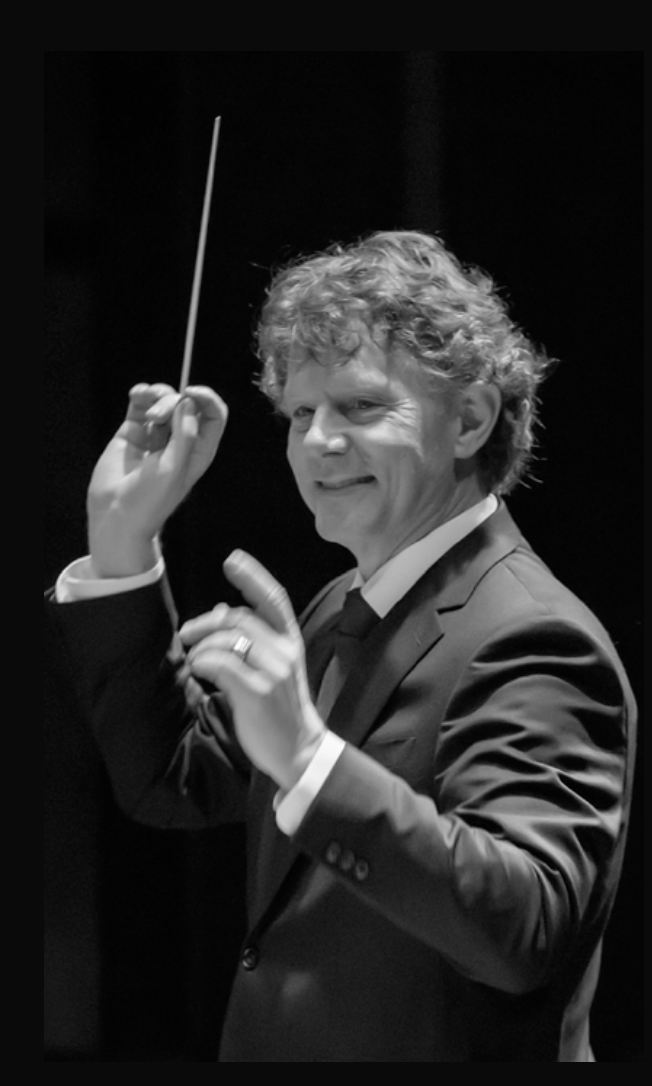
Michael Newnham
Music Director
Michael Newnham is best known for his intense and inspiring conducting style, based on a deep knowledge of the score and informed by a strong interest in languages, cultures and history. A born communicator, his open and direct contact with musicians and audiences creates performances full of expression and energy.
Along with being Music Director of Orchestra Toronto, he is also Music Director of the Peterborough Symphony Orchestra, and also held that title with Symphony New Brunswick and Camerata NB. Newnham has been instrumental in bringing these ensembles to new artistic heights and raising their profile on the provincial and national level.
Along with appearances in his native Canada, Newnham has also appeared at the helm of many orchestras and opera companies throughout Poland, Slovakia, the Czech Republic, Hungary, Austria, Italy and South Korea.
Endowed with a special passion and gift for working with young musicians, Michael founded the Kawartha Youth Orchestra in 2002, and has been a faculty member as conductor and chamber music coach at Music at Port Milford for several years. His involvement in educating young musicians is not limited to Canada. He spent two years as Guest Professor and Orchestra Conductor at Taegu-Hyosung University in South Korea.
Originally from Hamilton, Newnham is a graduate of the conducting class of prof. Bogusław Madey at the Chopin Academy of Music in Warsaw, Poland. He also studied at the Indiana University of Music and at the University of Toronto. A recipient of several awards, including the “Order of Merit” from the Republic of Poland, the “Best Conductor” Award from the East Slovakian State Opera, Newnham was recently granted the Turzanski Award for his services in promoting Polish music and culture in Canada.
Collaboration with Canadian composers has been central to Newnham’s life in music. In the summer of 2005, he was specially honoured to have been chosen by R. Murray Schafer to be the Music Director of an acclaimed production of Schafer’s “Patria: The Enchanted Forest”.
Before taking up the baton, Newnham began his musical career as a trombonist, playing with the Toronto and Kitchener-Waterloo Symphonies, as well as a member of the National Youth Orchestra of Canada. He currently lives in Peterborough with his wife, cellist Zuzanna, two daughters, and three cats, and is a home barista.

ABOUT ORCHESTRA TORONTO
Founded in 1954 as the Bennington Heights Community Orchestra and rebranded as Orchestra Toronto in 1998, our organization stands as a testament to the enduring power of music in building connections and enriching lives. From its humble beginnings, Orchestra Toronto has grown to become one of Canada’s oldest and largest volunteer orchestras, proudly serving the Greater Toronto Area and beyond with passion and dedication.
As we look towards the future, Orchestra Toronto remains steadfast in our commitment to entertaining and inspiring diverse communities. We envision a world where the love of symphonic music is embraced by future generations, and we are dedicated to making this vision a reality.
Join us on this musical journey as we continue to enrich lives, foster connections, and celebrate the transformative power of music.